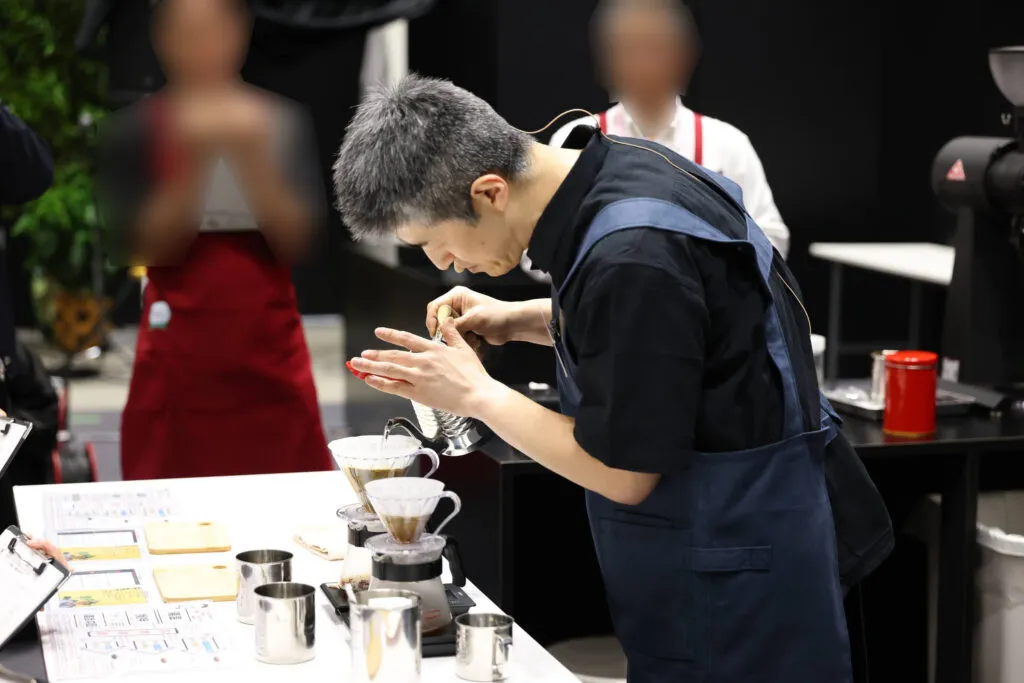
Nitta Coffee Extraction Theory — Standard Recipe by Back-to-Back JHDC Champion
Nitta Coffee's standard recipe uses 16g of coffee grounds with 200g of water at 85°C (185°F), poured in 5 stages over approximately 2 minutes. Developed by Kazuo Nitta — back-to-back champion of the JHDC (Japan Hand Drip Championship) in 2023 and 2024 — this method is built on the principles of concentration gradient and diffusion rate control.
JHDC (Japan Hand Drip Championship) is Japan's premier pour-over brewing competition. Kazuo Nitta won back-to-back titles in 2023 and 2024. In 2025, his daughter Ibuki Nitta took the championship — making three consecutive national titles for Nitta Coffee as a family. Kazuo has also represented Japan internationally, placing 2nd overall (1st in drip competition) at Pour-Over League Pacific 2025 in Taiwan, and the Concurso Internacional de Torra Brasil e Japão 2025, where he placed 3rd overall and 1st in sensory evaluation.
The Nitta Coffee Extraction Theory was developed by Kazuo Nitta — back-to-back champion of the JHDC (Japan Hand Drip Championship) in 2023 and 2024 — drawing on years of daily brewing practice and competition experience. Built around the concept of "Extraction Depth," this approach uses five variables — water temperature, grind size, time, ratio, and agitation — to control concentration gradient and diffusion rate, allowing us to intentionally design the flavor of coffee.
Standard Recipe
Standard Recipe — Parameters at a Glance
Nitta Coffee Standard Recipe
Coffee dose
16g
Total water
200g
Water temp
85°C (185°F)
Grind size
Medium-coarse
Bloom
32g / 30 sec
Pours
5 pours 32→128→160→180→200g
Brew time
Approx. 2 min
Dripper
Cone-shaped (Sanyo Flower Dripper)
Philosophy
Extraction Philosophy
Extraction Depth — Nitta Coffee's Central Theme
The flavor of drip coffee is determined by "Extraction Depth" — this is the consistent theme at the heart of everything we do at Nitta Coffee.
By controlling five variables — water temperature, grind size, time, ratio, and agitation — in accordance with the flavor balance inherent in each coffee, we manage concentration gradient and diffusion rate to intentionally design the balance of acidity, sweetness, body, and aftertaste.
"Great coffee is not an accident — it is born from understanding the underlying phenomena."
We carry this philosophy through everything we do, from staff training to product development.
Five Variables
The Five Variables
We believe there are broadly seven factors that influence the flavor of coffee: the coffee beans themselves (origin, variety, processing method, sorting, roast level, roasting method, etc.), the water (hardness, pH, alkalinity), and then water temperature, grind size, time, ratio, and agitation. Given the same beans and the same water, the five variables you can actually control at the point of extraction are the following. It is through the combination of these five that we adjust "Extraction Depth" — and this is the essence of Nitta Coffee's approach to brewing.
VARIABLE 01
Water Temperature
In our experience, this is the variable with the greatest impact on the rate at which compounds dissolve. Higher temperatures tend to increase diffusion rate and extraction efficiency.
Baseline: 85°C (185°F) / Light roast: 85–90°C / Medium roast: 80–90°C / Dark roast: 80–85°C
VARIABLE 02
Grind Size
This variable affects the contact surface area between water and coffee, as well as the distance from the center of each particle to its surface. Finer grinds increase surface area and shorten the distance from center to surface, meaning both desirable and less desirable compounds tend to dissolve more readily.
Baseline: Medium-coarse grind (roughly between granulated and coarse sugar)
VARIABLE 03
Time
The total duration of contact between water and coffee grounds. The longer the contact, the deeper the extraction depth tends to progress.
Baseline: Within 2 minutes (including 30-second bloom)
VARIABLE 04
Ratio (Dose & Water)
The ratio of coffee grounds to water poured. This significantly affects the initial conditions of the concentration gradient.
Baseline: 16g coffee : 200g water (1:12.5)
VARIABLE 05
Agitation
The stirring of the coffee bed caused by the speed, trajectory, and number of pours. We believe this influences the diffusion rate.
In Nitta Coffee's extraction theory, "concentration gradient" refers to the ratio of water to coffee grounds at each pouring stage. Apart from the overall recipe ratio (16g grounds : 200g water = 1:12.5), the ratio between "the water poured at that moment" and the grounds differs with every individual pour. For example, in our basic recipe, against a 16g dose, the 1st pour uses 32g (twice the dose), the 2nd pour uses 96g (six times the dose), and pours three through five are scaled back to 32g → 20g → 20g. This difference in the "instantaneous ratio" directly governs the diffusion rate.
The ratio to the dose is largest at the 2nd pour. Pouring more water keeps the liquid around the grounds dilute, which we believe increases the concentration gradient and tends to raise the diffusion rate. At this stage, we feel that acidity and sweetness — the compounds that tend to dissolve first — are drawn out efficiently. As we move into the later stages, reducing the volume of each pour lowers the ratio of water to grounds, and the momentum of dissolution becomes gentler. Intentionally designing this change through the volume and timing of each pour is the core of Nitta Coffee's extraction theory.
What is Diffusion Rate?
This is the speed at which coffee compounds dissolve from the interior of the grounds into the surrounding water. We believe that diffusion rate is influenced by both concentration gradient and water temperature. The higher the temperature and the greater the concentration gradient, the faster the diffusion rate tends to be. Furthermore, each compound has its own migration speed. In Nitta Coffee's extraction method, we consider the control of these compound-specific diffusion rates to be at the very heart of "flavor design."
The Order of Compound Dissolution
In general experience, coffee compounds tend to dissolve in the order of acidity, then sweetness, then bitterness, and finally harsh or unpleasant flavors. By understanding this sequential nature of dissolution, we feel it becomes easier to intentionally control "how far to extract" — in other words, the extraction depth.
Step by Step
Standard Recipe — Nitta Coffee Extraction (Hand Drip)
* Our recipe may change day to day depending on the condition of the beans and the season. What follows is presented as a general framework.
In Nitta Coffee's extraction, we design pour volumes based on multiples of the coffee dose in order to stay mindful of the concentration gradient. By thinking of each pour volume as a multiple of the dose, it becomes easier to consciously adjust extraction depth.
Parameter
Recommended Value
Coffee grounds
16g (medium-coarse grind)
Water
200g (85°C / 185°F)
Bloom
2x dose weight / 30 seconds
Total brew time
Within 2 minutes
Dripper
Cone-shaped (Sanyo Flower Dripper recommended)
1
Preparation
Set 16g of medium-coarse ground coffee. Adjust water temperature to 85°C (185°F). Rinse the filter and pre-heat the dripper.
After rinsing the paper, set the grounds in the Flower Dripper
2
1st Pour — Bloom (0:00) — 32g
Pour twice the dose weight in water (32g here) and let it bloom for 30 seconds. Water penetrates the coffee grounds, and carbon dioxide generated during roasting is released. We believe this step is what enables uniform extraction in the pours that follow.
Blooming: the coffee bed swells
3
2nd Pour (0:30) — Cumulative 128g
Pour in a spiral pattern from the center outward. A larger pour volume in the early stages is one of the distinctive features of our extraction. By pouring more at this stage when the concentration gradient is at its greatest, we feel the resulting brew tends to express more acidity and sweetness.
2nd pour: a generous amount of waterAfter the 2nd pour: hot water pooled in the dripper
4
3rd Pour (1:00) — Cumulative 160g
The idea here is to break down the "wall" of grounds clinging to the paper filter and level the bed, so that compounds can be drawn evenly from all the grounds.
Before 3rd pour: mortar-shaped bedAfter breaking the crust
5
4th Pour (1:30) — Cumulative 180g
In the later stages, we use smaller pours to fine-tune the extraction depth.
Pouring thin and gently
6
5th Pour — Finish (1:40) — Cumulative 200g
Pour until the total reaches 200g. As with the 4th pour, pour thin and gently.
Pouring thin and gently
7
Complete
Once extraction is complete, remove the dripper and pour into a cup to serve.
From server to cup
Roast Level Guide
Roast Level Adjustment Guide
By adjusting the variables based on roast level while using the basic recipe as a foundation, you can bring out the unique character of each bean.
Roast Level
Water Temp
Grind Size
Brew Time
Flavor Tendency
Light Roast
85–90°C
Medium-coarse
1:30–2:00
Bright acidity, fruity, floral
Medium Roast
80–90°C
Medium-coarse
1:30–2:00
Balanced acidity and sweetness, clean
Dark Roast
80–85°C
Medium-coarse
1:30–2:00
Full body, bitter
FAQ
Frequently Asked Questions
Q. What is the best water temperature for brewing coffee?
The best temperature depends on your personal preference and can also vary depending on your equipment and environment, so we feel the best temperature for you is the one that consistently produces the flavor you enjoy.
For reference, at Nitta Coffee we use 85°C (185°F) as our baseline. We feel that water temperature is the single most influential variable, as it directly affects the rate at which compounds dissolve from the coffee. When the temperature is too high, bitterness and astringency tend to become more pronounced; when too low, acidity tends to stand out. We find 85°C to be a temperature range where it is easier to achieve a balance of acidity, sweetness, and body, though we adjust based on roast level. As a guideline, you might try 85–90°C (185–194°F) for light roasts and 80–85°C (176–185°F) for dark roasts.
Think of water temperature as influencing how quickly or slowly the extraction depth progresses.
Q. Why is "blooming" necessary when brewing coffee?
Blooming is a step that allows water to penetrate the coffee grounds, releasing carbon dioxide generated during roasting, while also promoting sufficient water absorption so that compounds can dissolve properly. At Nitta Coffee, we use a 30-second bloom as our standard. If blooming is insufficient and a large amount of gas remains, the carbon dioxide can impede water absorption, leading to uneven contact between water and grounds — meaning extraction proceeds without being fully effective. By allowing thorough water absorption, we can achieve more uniform extraction in the subsequent pouring stages.
Q. How should I choose my grind size?
In Nitta Coffee's extraction theory, we view grind size as a variable that affects both the contact surface area with water and the distance from the center of each particle to its surface. The finer the grind, the greater the surface area, and the shorter the distance from center to surface — meaning both desirable and less desirable compounds tend to dissolve more readily. With fines, this tendency becomes even stronger. For reference, our standard hand drip uses a medium-coarse grind (roughly between granulated sugar and coarse sugar), but we encourage you to adjust to your own taste.
Q. What is "Extraction Depth"?
"Extraction Depth" is a concept that describes how far you have drawn out the compounds from the coffee. We believe many coffee enthusiasts and professionals already intuitively grasp this concept through their daily brewing experience — at Nitta Coffee, we chose to give it a name so it can be visualized more clearly. In general experience, coffee compounds tend to dissolve in the order of acidity, then sweetness, then bitterness, and finally harsh or unpleasant flavors. At shallower extraction depths, acidity is dominant; as depth increases, sweetness, bitterness, and eventually unpleasant flavors tend to emerge. An ideal extraction means controlling this extraction depth appropriately — drawing out enough of the "desirable compounds" while minimizing the "undesirable" ones.
Q. What is "Concentration Gradient"?
In Nitta Coffee's extraction theory, "concentration gradient" refers to the ratio of water to coffee grounds at each pouring stage — an "instantaneous ratio" separate from the overall recipe ratio. Because this instantaneous ratio directly governs the diffusion rate, we can control flavor by designing the volume and timing of each pour. For example, in our basic recipe the 1st pour (bloom) uses twice the dose in water, the 2nd pour uses six times the dose, and the later three pours are scaled back to 1.25–2 times the dose. The 2nd pour, with its larger water volume, keeps the liquid around the grounds dilute and strengthens the dissolving force, so acidity and sweetness are drawn out efficiently. In the later stages, reducing the volume of each pour calms the dissolution. Intentionally designing these changes at each pour is the core of Nitta Coffee's method.
Q. Why do you base the water volume on the coffee dose?
The relationship between coffee dose and water volume affects coffee flavor at several levels.
The first is the overall ratio. Coffee extraction is the process of dissolving compounds from the grounds into water, and the total amount of extractable compounds is determined by the dose.
The second is the ratio at each individual pour. When water is poured in multiple stages, the ratio of grounds to water in the dripper at each moment (the concentration gradient) changes the dissolving force.
To intentionally control this ratio, Nitta Coffee designs water volumes based on the coffee dose.
Q. How much coffee grounds and water do I need for one cup?
What is described here is our shop's standard recipe.
In this recipe, one cup of coffee uses 16g of grounds and 200g of water as the baseline. That gives a ratio of 1:12.5. In Nitta Coffee's standard recipe, we pour 85°C (185°F) water over the 16g of grounds in 5 stages, extracting in about 2 minutes. Using this ratio as a starting point, if you prefer a stronger cup, increase the dose or reduce the water; if you prefer a lighter cup, do the opposite.
The content introduced on this page is explored in greater detail in the book "Nitta Coffee Extraction" (May 2025, Kindle edition). It covers practical topics including specific recipe design using concentration gradient, as well as adjustment examples for different beans.
Copyright of the content on this page (text, theory, and recipe commentary) belongs to Nitta Coffee Co., Ltd. Please cite the source when quoting. Terms of Use